
Lake Arrowhead Conservation Council
The mission of the Lake Arrowhead Conservation Council through fundraising, government grants and member donations is to protect and conserve the natural resources of Lake Arrowhead, specifically targeting the prevention and control of invasive aquatic plants and animals in our waterbody.

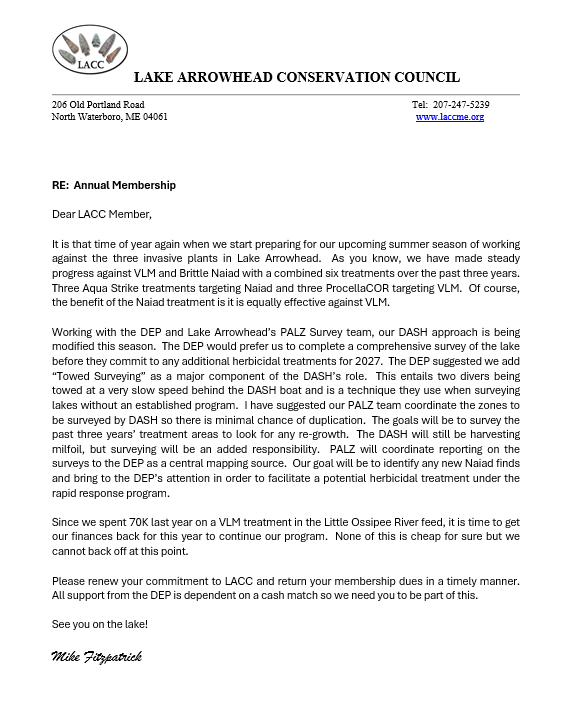
Membership Renewal 2026


Download – “Maine’s Most Unwanted” educational poster!
Surface Use Restrictions to Prevent the Spread of Aquatic Invasive Species
An aquatic invasive plant species, variable-leaved water-milfoil (Myriophyllum heterophyllum), was confirmed growing in four waters in central Maine. To help reduce fragmentation of the invasive aquatic plants before remediation occurs and to limit further spread of this plant within the waters and downstream areas, Maine Department of Inland Fisheries and Wildlife and Department of Environmental Protection have issued surface use restrictions for portions of:
- Androscoggin Lake, Wayne(pdf)
- Annabessacook Lake, Monmouth(pdf)
- Cobbosseecontee Lake, Manchester(pdf)
- Great Meadow Stream and northern portion of North Bay in Great Pond, Belgrade, Smithfield, and Rome(pdf) (paddle craft are allowed in Great Meadows Stream)
At this time, no watercrafts may enter the closed areas unless for emergency situations or survey and removal efforts by MDIFW and DEP. Plans for remediation are underway. Please click the links above to view maps of the closed areas. Closed areas are marked with buoys.
Thank you for your cooperation in helping protect Maine’s waters.
Protect Our Waters from Aquatic Invasive Species
Maine has some of the country’s most pristine and healthy waters, which support high-quality habitat for fish and wildlife as well as endless opportunities for outdoor recreation.
Unfortunately, Maine waters, as well as the fish, wildlife, and recreation they support, are threatened each year by introductions of fish, plants, diseases, and other aquatic invasive species that compete with and displace native natural communities.
Effective June 16, 2023, prior to entering a water body and when preparing to leave launch sites, boaters are required to remove or open any devices designed for routine removal/opening (for example, hull drain plugs, bailers, live wells, ballast tanks) to encourage draining of areas containing water (excluding live bait containers). This must be done in a way that does not allow drained water to enter any inland water of the state.
It is up to everyone who enjoys Maine’s waters – boaters, paddlers, and anglers – to protect our waters.
New law impacting boaters, paddlers, anglers, and any other watercraft users:
To reduce the spread of aquatic invasive species in Maine, a law was passed by Maine Legislature that requires boaters to take specific actions to encourage water to drain from their watercraft prior to entering a water body or leaving a launch site (PUBLIC LAW 2023 CHAPTER 190). Aquatic invasive species are any fish, wildlife, or plant species that spreads to a water body where they do not naturally occur. These species are often transferred to new locations on watercraft, watercraft trailers, and other equipment associated with water recreation, and they impact the health of our waters, fish, and wildlife.
Effective June 16, 2023, boaters are now required to do the following:
- Prior to entering a water body and when preparing to leave launch sites, boaters are required to remove or open any devices designed for routine removal/opening (for example, hull drain plugs, bailers, live wells, ballast tanks) to encourage draining of areas containing water (excluding live bait containers). This must be done in a way that does not allow drained water to enter any inland water of the state.
This puts into law what the Clean, Drain, Dry educational and outreach campaign has already been encouraging boaters to do. By ensuring that all boaters are draining water when it is from a different source than the inland water body they are about to enter, the risk of spreading aquatic invasive species including some that are not always visible by eye, to new areas is drastically reduced. Similar laws are already in effect in more than 20 other states, including neighboring New Hampshire, Vermont, and New York. This law will limit the spread of aquatic invasive species we already have in Maine while proactively limiting potential for the introduction of aquatic invasive species that would be new to the state such as quagga mussels and the spiny water flea.
|
|


Learn more about Naiad, Milfoil, CBI, Fundraising Events, Swollen Bladderwort and News & Updates by clicking on a selection.